How much do you really need to start trading stocks on the Philippine Stock Exchange (PSE) Interestingly, the answer is that there is no fixed minimum amount. It all depends on two things:
(1) The stock’s price – Some stocks in the PSE trade for less than P1.00 each, others for hundreds or even thousands of pesos per share.
(2) The minimum number of shares you can buy – Known as the board lot, this sets the smallest allowable quantity per order for a given stock price range.
Put those two together and you’ll know the minimum cash you need for your first trade.
To help you determine the “minimum number of shares that you can buy,” you can read our article How to Use the PSE Board Lot. But keep in mind that you also need to consider fees, taxes, and commissions, as these charges increase your buying costs and decrease your selling proceeds.
So before you click that Buy or Sell button, it’s important to know these charges so you can plan your trades better and avoid surprises.
Recent Updates
In recent years, several reforms have been reshaping trading costs in the PSE. Specifically:
(1) Broker commissions are now fully flexible, after the SEC and PSE removed the previous minimum requirement. Under SEC Memorandum Circular No. 7, Series of 2024 (dated April 17, 2024), the previous minimum broker’s commission (0.25% or P20, whichever is lower) was removed.
(2) Meanwhile, the Stock Transaction Tax (STT) on selling transactions has dropped significantly from 0.60% to 0.10%, and the Documentary Stamp Tax (DST) on initial stock issuances has fallen from 1.0% to 0.75%, following the passage of the Capital Markets Efficiency Promotion Act (CMEPA). Starting July 1, 2025, the STT is officially only 0.1% of the gross selling price (from 0.6%), which means less money going to taxes and more staying in a trader’s pocket.
(3) However, VAT will now be charged on the PSE Transaction Fee for every trade executed. Starting September 4, 2025, a 12% Value Added Tax (VAT) will be applied to the PSE transaction fee.
Let’s go through all these charges, then we’ll show you updated sample computations so you’ll see exactly how much is added when you buy and how much is deducted when you sell.
PSE Stock Transaction Fees
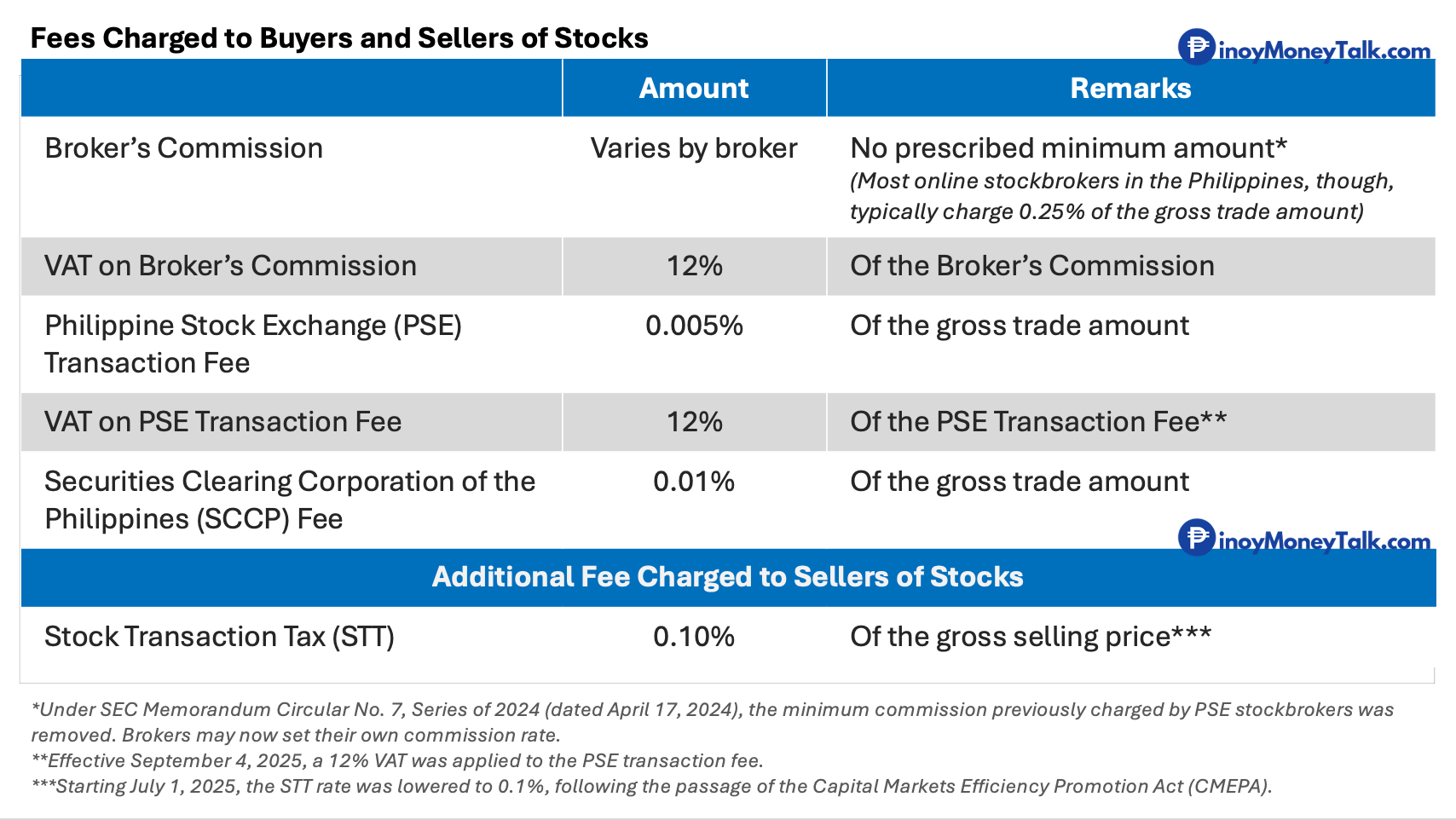
Below is a summary of the commission, taxes, and fees charged to buying and selling transactions in the PSE.
Check out other articles you might find interesting:
1. Broker’s Commission
The broker’s commission is the fee charged by stock brokerage companies whenever a trader buys or sells stocks through that broker. Think of it as a “service fee” for using their platform. It’s how brokers earn, and brokers apply this to every fulfilled transaction—regardless if the customer made a profitable trade or a losing one.
Before April 2024, the PSE required brokers to charge a minimum of 0.25% of the trade value or P20, whichever was higher, and a maximum of 1.5% of the trade amount. That P20 minimum rule meant that if the broker’s commission was smaller than P20, you’d still be charged P20. Most online brokers, such as COL Financial, BPI Trade, and First Metro Securities, charged 0.25% for online trades, while live or phone-assisted trades could cost you 1% to 1.5%.
However, in April 2024, the PSE and the Securities and Exchange Commission (SEC) removed the minimum fee requirement, allowing brokers to set their own commission rates in a bid to “help spur trading in the stock market.” That means brokers now set their own rates.
Interestingly, even though the PSE and SEC made it possible for brokers to charge less, most online brokers in the Philippines still stick with the standard 0.25% commission, with one broker (Luna Securities) offering lower rate (starting at 0.2% for trades between P2,500 and P100,000 and dropping to as low as 0.12% for a trade size of at least P1 million).
Here’s a table summarizing the commissions charged by several online stockbrokers in the Philippines.
| Online Stockbroker | Broker’s Commission |
|---|---|
| COL Financial | 0.25% of gross trade amount |
| BDO Securities | 0.25% of gross trade amount |
| BPI Securities (BPI Trade) | 0.25% of gross trade amount or P20.00, whichever is higher |
| First Metro Securities | 0.25% of gross trade amount |
| PhilStocks | 0.25% of gross trade amount |
| GStocks (AB Capital Securities) | 0.25% of gross trade amount |
| Luna Securities | 0.12%-0.20% of gross trade amount |
Take note that the broker’s commission is also subject to the government’s 12% Value-Added Tax (VAT).
2. SCCP Fee or Clearing Fee
The clearing fee is charged by the Securities Clearing Corporation of the Philippines (SCCP), a wholly-owned subsidiary of the PSE which facilitates clearing and settlement of stock transactions. This fee, set at 0.01% of the transaction amount, ensures the proper transfer of stocks and payment between buyers and sellers.
What’s the purpose of clearing and settlement in stock trades? When you buy a stock, you pay money and, in return, you get ownership of that stock. if you’re selling, you turn over your stocks to the new owner and receive cash proceeds in return.
There is an agency, the SCCP, that facilitates stock clearing and settlement, making sure the money from the buyer reaches the seller, and the stocks from the seller are transferred to the buyer. It’s a small fee—0.01% of the transaction amount—but it applies to both buying and selling.
3. PSE Transaction Fee
Since all trades of listed stocks go through the Philippine Stock Exchange, the PSE charges its own small cut: 0.005% of the gross trade amount for every completed order. Again, this applies to both buy and sell transactions of stocks.
Starting September 4, 2025, the 12% VAT will also now be applied to the PSE transaction fee, not just to the broker’s commission.
4. Stock Transaction Tax (only for Sellers)
Most newbie stock traders typically ask this question: Do I need to pay tax (specifically, capital gains tax) on the sale of stocks in the PSE?
Simple answer: No. Stock traders do not have to report their stock trading profits in their Income Tax Return (ITR) or pay capital gains tax (CGT) on any income made from the stock market.
Tax is still collected, though, and that comes in the form of the Stock Transaction Tax (STT) which is applied to every stock sale transaction.
Typically, capital gains tax (CGT) is charged on transactions that resulted in a profit or gain. In the PSE, however, even if you sold your stocks at a loss, you are still required to pay the STT.
Previously, the STT was a fixed 0.6% of the gross selling price, but following the passage of the CMEPA Law or the Capital Market Efficiency Promotion Act, the stock transaction tax has been reduced to 0.1% effective July 1, 2025.
Here’s how much more you keep now compared to before. This tax rate reduction is definitely a welcome development, but take note that the STT applies to all sell trades, even if you incur a loss.
| Trade Amount | Old STT (0.6%) | New STT (0.1%) | Savings |
|---|---|---|---|
| P10,000 | P60.00 | P10.00 | P50.00 |
| P50,000 | P300.00 | P50.00 | P250.00 |
| P100,000 | P600.00 | P100.00 | P500.00 |
Summary of PSE Trading Fees (with CMEPA Update)
Here’s a table summarizing the commissions, fees, and taxes charged on buying and selling transactions in the PSE.
| Fees and Charges | Rate or Amount | Charged to |
|---|---|---|
| Broker’s Commission | Depends on the broker; no more minimum amount | Buyers and Sellers of stocks |
| VAT on Broker’s Commission | 12% of Broker’s Commission | Buyers and Sellers of stocks |
| PSE Transaction Fee | 0.005% of gross trade amount | Buyers and Sellers of stocks |
| VAT on PSE Transaction Fee | 12% of PSE Transaction Fee | Buyers and Sellers of stocks |
| SCCP or Clearing Fee | 0.01% of gross trade amount | Buyers and Sellers of stocks |
| Stock Transaction Tax | 0.10% of gross trade amount | Sellers only |
Sample Computations: Buying Stocks in the PSE
Buying stocks involves more than just stock price times quantity. Fees and taxes increase your investment cost. Let’s walk through an example to illustrate this.
Example 1. You plan to buy 10 shares of Globe Telecom (GLO) at P2,500 each. Your broker charges a 0.25% commission. What’s your total cost?
It’s not just P25,000.00 (10 shares x P2,500.00 price per share) because you need to consider the commissions, fees, and taxes.
The computation is as follows:
Gross Transaction Amount: 10 shares of GLO * P2,500 share price = P25,000.00Add: Broker's Commission: 0.25% * P25,000 = P62.50
Add: VAT on Broker's Commission: 12% * P62.50 = P7.50
Add: PSE Transaction Fee: 0.005% * P25,000 = P1.25
Add: VAT on PSE Transaction Fee: 12% * P1.25 = P0.15
Add: SCCP or Clearing Fee: 0.01% * P25,000 = P2.50
TOTAL BUYING COST: P25,000.00 + P62.50 + P7.50 + P1.25 + P0.15 + P2.50 = P25,073.90
Therefore, to buy 10 shares of GLO at P2,500 apiece, you’ll need to pay a total of P25,073.90. That means you’ll spend P73.90 more than the gross trade price because of fees and taxes.
Example 2. Let’s assume this time that your broker charges the following commission rate: 0.10% or P20.00, whichever is higher. You intend to buy 100 shares of Cebu Air Inc. (Cebu Pacific – CEB) at P32.00 per share. How much will you actually pay in total for this stock purchase?
To compute the total cost, let’s break down the fees:
Gross Transaction Amount: 100 shares of CEB * P32.00 share price = P3,200.00Add: Broker's Commission = P20.00 (Since 0.10% of P3,200.00 is P3.20, which is less than the minimum P20.00, the broker will charge the minimum commission of P20.00.)
Add: VAT on Broker's Commission: 12% * P20.00 = P2.40
Add: PSE Transaction Fee: 0.005% * P3,2000 = P0.16
Add: VAT on PSE Transaction Fee: 12% * P0.16 = P0.0192, rounded up to P0.02
Add: SCCP or Clearing Fee: 0.01% * P3,200 = P0.32
TOTAL BUYING COST: P3,200.00 + P20.00 + P2.40 + P0.16 + P0.02 + P0.32 = P3,222.90
If you buy 100 shares of Cebu Pacific (CEB) at P32.00 each, your total cost is P3,222.90. You’ll spend P22.90 more than the gross trade amount because of fees and taxes.
Sample Computation: Selling Stocks in the PSE
If you’re selling stocks, how much net cash proceeds will you receive?
Basically, you’ll be paying the same fees above, plus the 0.1% stock transaction tax. All in all, these fees, of course, reduce the gross selling price that you will receive.
Let’s use the same Globe Telecom assumptions from Example 1 for consistency.
Example 3. Instead of buying Globe Telecom (GLO) shares, we will sell 10 shares at P2,500.00 each. If the broker’s commission is 0.25%, how much net cash will you actually receive after selling?
Gross Transaction Amount: 10 shares * P2,500 share price = P25,000.00Less: Broker's Commission: 0.25% * P25,000 = P62.50
Less: VAT on Broker's Commission: 12% * P62.50 = P7.50
Less: PSE Transaction Fee: 0.005% * P25,000 = P1.25
Less: Vat on PSE Transaction Fee: 12% * P1.25 = P0.15
Less: SCCP or Clearing Fee: 0.01% * P25,000 = P2.50
Less: Stock Transaction Tax: 0.1% * P25,000 = P25.00
NET SELLING PROCEEDS = P25,000.00 - P62.50 - P7.50 - P1.25 - P0.15 - P2.50 - P25.00 = P24,901.10
If you sell 10 shares of Globe Telecom (GLO) at P2,500 each, you’ll pay P98.90 in total charges. The net amount you’ll receive for this selling transaction is P24,901.10.
Example 4. You’re selling 1,000 shares of a stock at P2.75 per share. Your broker charges 0.25% commission or P5.00 minimum. How much is your net cash proceeds from this transaction?
Try to compute this yourself before checking the answer below. Did you get it right?
Gross Transaction Amount: 1,000 shares * P2.75 share price = P2,7500.00Less: Broker's Commission = P6.88 (The broker charges P5.00 minimum or 0.25% of the trade amount, i.e,. 0.25% of P2,750.00 = P6.875, rounded up to P6.88.)
Less: VAT on Broker's Commission: 12% * P6.88 = P0.8256 or P0.83
Less: PSE Transaction Fee: 0.005% * P2,750 = P0.1375 or P0.14
Less: VAT on PSE Transaction Fee: 12% * P0.14 = P0.0168 or P0.02
Less: SCCP or Clearing Fee: 0.01% * P2,750 = P0.275 or P0.28
Less: Stock Transaction Tax: 0.1% * P2,750 = P2.75
TOTAL CASH PROCEEDS FROM SALE OF STOCKS: P2,750.00 - P6.88 - P0.83 - P0.14 - P0.02 - P0.28 - P2.75 = P2,739.10
In summary, you’ll be charged P10.90 total fees and taxes, giving you net cash proceeds of P2,739.10.
Breakeven price increase to cover “round-trip” Costs
When you buy and sell stocks in the PSE, you don’t just pay for the stock price; you also shoulder several fees and taxes. To avoid losses, your stock’s price must rise enough to cover both the buying costs and selling costs (the so-called “round-trip cost”).
So what’s the breakeven price to ensure you’ll make a profit when you sell? Well, it depends on the broker’s commission. But assuming your broker charges a 0.25% commission:
I. Buying Costs:
- Broker’s Commission = 0.25% (may vary per broker)
- VAT on Commission = 12% * 0.25% commission = 0.03%
- PSE Transaction Fee = 0.005%
- VAT on PSE Fee = 12% of 0.005% = 0.0006%
- SCCP Fee = 0.01%
- Total Buy-side Costs = 0.2956% of gross trade amountII. Selling Costs:
- Broker’s Commission = 0.25% (may vary per broker)
- VAT on Commission = 12% * 0.25% commission = 0.03%
- PSE Transaction Fee = 0.005%
- VAT on PSE Fee = 12% of 0.005% = 0.0006%
- SCCP Fee = 0.01%
- Stock Transaction Tax (STT) = 0.10%
- Total Sell-side Costs = 0.3956% of gross trade amountIII. Total Round-Trip Cost: 0.2956% + 0.3956% = 0.6912%
In short, if your broker charges 0.25% commission, your round-trip cost of buying and selling is about 0.6912% (or 0.70%, rounded up) of the trade value. This means a stock priced at P100 must climb to at least P100.70 before you can break even and start producing net gains.
Now, you’re ready to trade stocks. Good luck and happy investing!
Check out other articles you might find interesting:
